
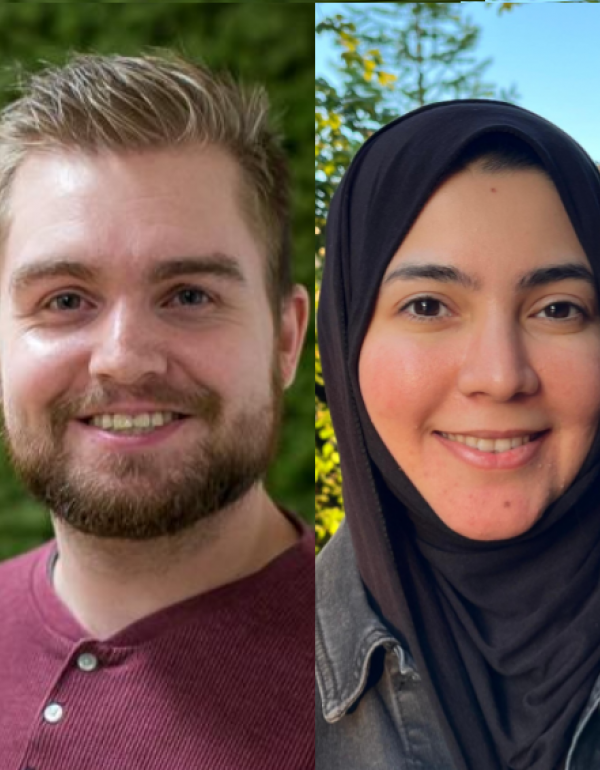
Marvin Martens and Sidra Adil are researchers in the Department of Translational Genomics (TGX) at Maastricht University. Their work focuses on connecting Adverse Outcome Pathways (AOPs) with transcriptomics data and developing practical approaches for mechanistically informed, animal-free chemical safety assessment.
Marvin is a postdoctoral researcher with a background in biomedical sciences and bioinformatics. His research focuses on making AOP knowledge FAIR, computable, and easier to integrate with molecular data. He develops knowledge resources and tools such as the AOP-Wiki RDF knowledge graph and the molAOP Builder and Analyser web applications. His work combines semantic web technologies, transcriptomics, and computational modelling to help researchers interpret molecular changes in the context of toxicity pathways. He contributes to initiatives including VHP4Safety and the ELIXIR Toxicology Community.
Sidra is a PhD candidate with a background in microarray and RNA-seq data analysis. As part of EFSA’s TXG-MAP project, her research connects AOPs to transcriptomics data, allowing gene expression measurements to be interpreted as specific steps in a toxicity pathway rather than simply as lists of changed genes. A central challenge is that many Key Events in the AOP-Wiki lack the ontology annotations needed to establish these connections. Much of her work therefore involves systematically annotating Key Events across organ-specific AOP networks.
Together, Marvin and Sidra combine computational infrastructure, ontology annotation, and transcriptomics analysis to make AOP knowledge more accessible and applicable. Their work supports the interpretation of molecular data in a transparent biological context and advances the use of new approach methodologies (NAMs) in chemical risk assessment.
OpenTox Summer School 2026
Adverse Outcome Pathways (AOPs) organise mechanistic knowledge from a molecular initiating event through a series of Key Events (KEs) to an adverse outcome, but connecting them to real molecular measurements remains a practical bottleneck. This session introduces the molecular AOP (molAOP) workflow through two free, browser-based tools developed within VHP4Safety. The Molecular AOP Builder curates and approves mappings between AOP KEs and biological pathways (WikiPathways) and Gene Ontology terms, using language-model similarity scoring to suggest candidates for expert review. The Molecular AOP Analyser consumes those curated mappings to test gene-expression datasets for KE enrichment (Fisher's exact test or GSEA, with false-discovery-rate correction), visualises the results as interactive AOP networks, and generates shareable reports.
After a short introduction to the AOP framework and the molAOP concept, participants work through a guided demonstration and hands-on exercises using datasets provided in the tools. Attendees will run an enrichment analysis end to end, interpret the resulting KE network, and curate a KE-pathway mapping using guest accounts. No installation, prior AOP experience, or programming is required; only a laptop and a web browser. By the end, participants will be able to map molecular data onto AOP KEs and interpret the outcome in a weight-of-evidence context.