
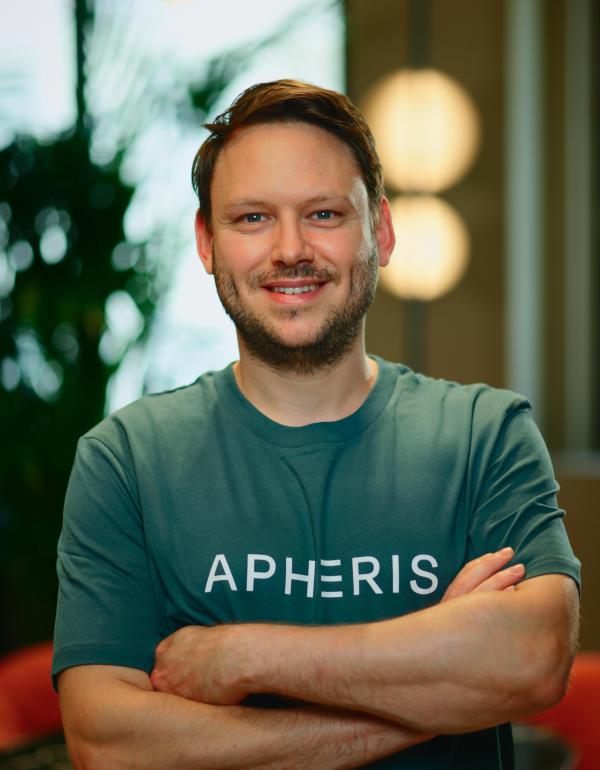
Lewis Mervin, PhD, is Principal Machine Learning Engineer at Apheris, an AI drug discovery company that works with more than 15 pharmaceutical companies, nine of them top-20. Apheris customizes and fine-tunes discovery models on the proprietary data locked inside pharma, spanning co-folding, binding affinity, and ADMET, so that predictions become accurate enough to change decisions in live drug programs. Lewis leads the privacy preserving methods that run across the company's federated data networks, and the scientific work on Apheris's toxicity and ADME modelling. He has over a decade of experience applying machine learning in drug discovery. Before Apheris he founded a molecular property prediction platform and then spent six years at AstraZeneca in Ola Engkvist's team, working across chemistry, ADMET, and pharmacology. He holds a PhD in Chemistry from the University of Cambridge. Lewis was among the leading contributors to large-scale collaborations such as MELLODDY, one of the largest cross-pharma federated learning initiatives, and JUMP-Cell Painting, with primary responsibility for privacy-preserving modelling approaches on the AstraZeneca side. He remains active in the open cheminformatics community, with work spanning automated QSAR modelling, uncertainty quantification, and mode-of-action analysis. At OpenTox 2026 he will discuss how federated learning across pharmaceutical companies can improve toxicity prediction by training models across the industry's diverse, drug-relevant safety data no single organization holds alone, and what this means for more trustworthy, data-driven risk assessment.
OpenTox Virtual Conference 2026
Despite improved modelling approaches, predicting a compound's downstream safety and toxicological effects from its molecular perturbation of cellular biology remains one of the hardest problems in preclinical drug discovery. Paired perturbation and toxicity or safety datasets are distributed across pharma and biotech organisations, whilst public resources only cover narrow slices of chemical and endpoint space that matters for drug design in practice. To address this, we present an state-of-the-art federated approach to virtual-cell modelling, in which partner organisations train locally on their own proprietary data and only model updates and not the underlying data are ever shared or aggregated. This enables a shared model to benefit from collective chemical and biological knowledge across all partners, while each data stays entirely with the custodian. At a high level, a shared component learns to predict how perturbations shifts cellular states, while partner-specific components remain private whilst specialising this signal towards toxicological and safety readouts. These spanning areas such as cytotoxicity, mitochondrial toxicity, hepatotoxicity, cardiotoxicity, genotoxicity, and beyond. Signals are trained jointly rather than single-task, so we expect the toxicological read-outs and the underlying cell-state predictions to reinforce one another. Standardised core experiments anchor the model whilst compnies can contribute their own endpoints. This talk introduces the concept, how federation works for computational toxicology, and the open scientific questions being addressed by the initiative. We will be evaluating the model on the common benchmarks used by the OpenTox community to stress-test where this approach adds the most value.