
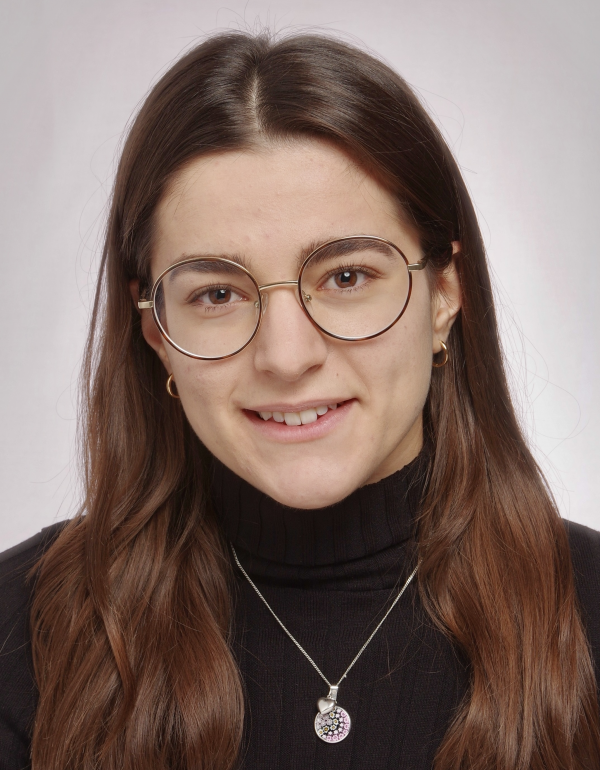
Lidwina Gerner is a PhD researcher at the Swiss Centre for Applied Human Toxicology (SCAHT) and the University of Basel, working in developmental and regulatory toxicology. She holds a Bachelor’s degree in Pharmaceutical Sciences and a Master’s degree in Drug Sciences with a specialisation in toxicology from the University of Basel. She joined SCAHT in 2024 for her Master’s thesis, where she worked on the development of an Adverse Outcome Pathway (AOP) in developmental neurotoxicity. Building on this work, her PhD research focuses on advancing New Approach Methodologies (NAMs) for chemical safety assessment, with a particular interest in AOP development. She is involved in the AI4AOP Challenge, a joint initiative of SCAHT and the European Commission’s Joint Research Centre (JRC), which explores how large language models can support transparent, traceable, and expert-led AOP development.
OpenTox Virtual Conference 2026
Adverse outcome pathways (AOPs) organise mechanistic toxicological knowledge linking molecular perturbations to adverse outcomes and provide an important foundation for next-generation risk assessment. However, AOP development, particularly the establishment of key event relationships (KERs), remains resource-intensive, requiring extensive literature retrieval, evidence synthesis and expert judgement. Artificial intelligence, particularly large language models (LLMs), could support these activities, but challenges such as hallucinated content, incomplete citation traceability, overinterpretation and non-transparent evidence use currently limit their scientific reliability. To explore how LLMs can support KER development while maintaining transparency, traceability and meaningful expert oversight, the European Commission’s Joint Research Centre (JRC) and the Swiss Centre for Applied Human Toxicology (SCAHT) initiated the AI4AOP Challenge. Twenty-one participants independently applied AI-assisted approaches to retrieve, extract and organise evidence for two target KERs that had previously been developed without AI support. These approaches were subsequently discussed and consolidated during an in-person hackathon at the JRC in Ispra, informing the development of a community consensus workflow and associated guardrails for AI-assisted KER development. To illustrate its application, the workflow was evaluated in a case study against an expert-curated reference set. The resulting six-stage, expert-led workflow covers problem formulation, topic familiarisation, context engineering, literature retrieval, evidence extraction and KER drafting, and evidence evaluation. It defines where AI can support KER development while establishing critical expert checkpoints for scope definition, contextualisation, evidence interpretation and output evaluation. Associated guardrails address source-grounded reasoning, citation traceability, transparent evidence classification, uncertainty reporting and independent critical review. In the subsequent case study, these principles were incorporated into a four-prompt sequence and tested using two LLMs under two context conditions. All four configurations produced structured and transparent KER drafts suitable for expert review, while differences in evidence retrieval and integration highlighted the importance of KER-specific context and expert verification. The presentation will introduce the AI4AOP Challenge, the resulting workflow and guardrails, and their application in the case study, while highlighting practical lessons learned. Together, these elements provide a transferable, expert-led framework for transparent and traceable LLM-assisted KER development.