
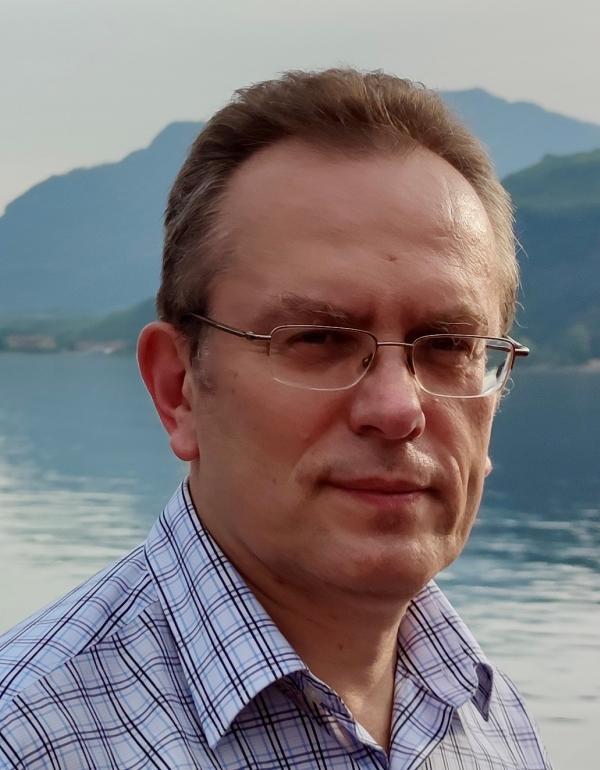
Dr. Igor Tetko received his MSc from the Moscow Institute of Physics and Technology (summa cum laude - red diploma), one of the top-ranked Universities in the Soviet Union. He carried out his postdoctoral studies in neuroinformatics at the University of Lausanne, where he developed algorithms for the analysis of EEG data, synfire chains and theoretical modeling of thalamo-cortical organization of the brain. Since 2001, Dr. Tetko is a group leader in Chemical Informatics at Helmholtz Zentrum München, as well as CEO of BigChem GmbH. Dr. Tetko has co-authored >200 publications in chemoinformatics, bioinformatics, neuroinformatics and machine learning https://scholar.google.com/citations?user=eMe8DOkAAAAJ. He is a Program Chair of the International Conference on Artificial Neural Networks (https://e-nns.org/icann2026) and organiser of 22nd International Workshop on Quantitative Structure-Activity Relationships in Environmental and Health Sciences - QSAR 2027 (https://qsar.eu). He currently coordinates Horizon Europe Marie Skłodowska-Curie Innovative Training Network European Industrial Doctorates project Explainable AI for Molecules - AiChemist (https://aichemist.eu). Igor is an Associate Editor of the ACS ChemResTox (https://pubs.acs.org/journal/crtoec) and Journal of Cheminformatics (https://link.springer.com/journal/13321).
OpenTox Summer School 2026
OCHEM - platform for winning Challenges!
Following a brief overview of the OCHEM platform (https://ochem.eu) and its open-source version (https://github.com/openochem), I will discuss successful examples of OCHEM’s use in competitions such as the US EPA ToxCast Challenge [1], Tox21 Challenge, 1st Joint EUOS/SLAS Kaggle Challenge [3], Tox24 Challenge [4], and EUOS25 [5]. I will demonstrate the typical stages and strategies employed in these contests and overview the main findings. The importance of using eXplainable AI (XAI) to interpret models and tools to do it within the OCHEM platforms will be also discussed and exemplified.
- Novotarskyi, S.; Abdelaziz, A.; Sushko, Y.; Körner, R.; Vogt, J.; Tetko, I. V. ToxCast EPA in Vitro to in Vivo Challenge: Insight into the Rank-I Model. Chem. Res. Toxicol. 2016, 29 (5), 768–775. https://doi.org/10.1021/acs.chemrestox.5b00481
- Abdelaziz, A.; Spahn-Langguth, H.; Schramm, K.-W.; Tetko, I. V. Consensus Modeling for HTS Assays Using In Silico Descriptors Calculates the Best Balanced Accuracy in Tox21 Challenge. Front. Environ. Sci. 2016, 4. https://doi.org/10.3389/fenvs.2016.00002
- Hunklinger, A.; Hartog, P.; Šícho, M.; Godin, G.; Tetko, I. V. The openOCHEM Consensus Model Is the Best-Performing Open-Source Predictive Model in the First EUOS/SLAS Joint Compound Solubility Challenge. SLAS Discov. 2024, 29 (2), 100144. https://doi.org/10.1016/j.slasd.2024.01.005
- Eytcheson, S. A.; Tetko, I. V. Which Modern AI Methods Provide Accurate Predictions of Toxicological Endpoints? Analysis of Tox24 Challenge Results. Chemical Research in Toxicology 38 (9), 1443-1451. https://doi.org/10.1021/acs.chemrestox.5c00273
- Skopelitou, K.; Rossella, F.; Awuku Larbi, R.; Gribbon, P.; Cirino, T.; Tetko, I.V. 2nd EUOS/SLAS Joint Challenge: Prediction of spectral properties of compounds SLAS Technol. 2025 Nov 22:100374. 10.1016/j.slast.2025.100374